Six months ago, we published A Guide to Marketplaces. Marketplace companies comprise an important part…


Marketplaces / Social / Collaboration / Network Effects
In a recent Invest Like The Best podcast, the guest, who goes by the pseudonym Modest Proposal, described a 2×2 matrix for segmenting marketplace types. It’s a simple, yet very effective way to think about the differences in online marketplaces, from the original product marketplaces like eBay to the emerging services marketplaces. One axis represents […]
 boris
borisSix months ago, we published A Guide to Marketplaces. Marketplace companies comprise an important part…
Nearly two years ago, we published our first ebook, A Guide to Marketplaces. Towards the…
In a recent Invest Like The Best podcast, the guest, who goes by the pseudonym Modest Proposal, described a 2×2 matrix for segmenting marketplace types. It’s a simple, yet very effective way to think about the differences in online marketplaces, from the original product marketplaces like eBay to the emerging services marketplaces. One axis represents products or services, and the other axis represents homogenous or heterogenous.
Here’s our take on a marketplace matrix with some key examples for each quadrant.
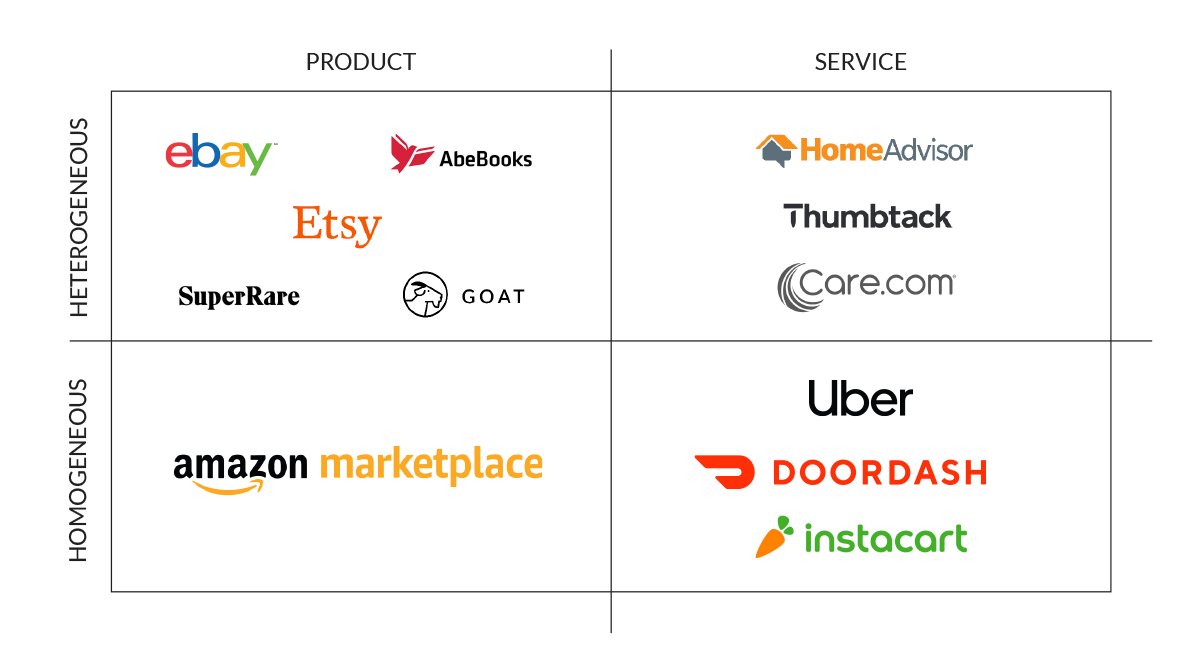
Product/heterogenous:
This is the original marketplace category. These platforms bring together buyers and sellers of unique goods, reducing friction and unlocking value by breaking down geographic barriers. Buyers and sellers are no longer limited to their local pool: a buyer can find a specific item from a seller halfway across the world and vice versa.
Key characteristics:
Product/homogenous:
These marketplaces sell commoditized products, from diapers and paper towels to USB cables. Customers may develop preferences for one brand over another, but there’s nothing particularly unique or exclusive about the inventory.
Key characteristics:
Services/homogeneous:
A services marketplace has often some kind of physical nexus, where something (the service) is performed offline. Marketplaces in this quadrant offer standard well-described tasks that get further commoditized by platform rules and the user interface. For example, with ride sharing services, consumers care about getting from point A to point B – they don’t particularly care who picks them up, the type of car, etc.
Key characteristics:
Services/heterogeneous:
These platforms match buyers and providers for more complex, non-commoditized services, such as home services. Services are delivered offline and can’t typically be represented in a single easy-to-order SKU. As a result, it’s hard for these marketplaces to be part of the transaction and typically rely on lead generation for their business model.
Key characteristics:
By categorizing marketplaces into a matrix, it’s clear that each type has a unique set of challenges, success factors, and opportunities. It’s impossible to appreciate the power of network effects, for example, without understanding the frequency and commoditization of the underlying product or service. And if you’re interested in exploring any of these topics in more detail, we recently published the third edition of A Guide to Marketplaces.
Version One
Over the past 13+ years, we’ve written a lot on this blog — investment announcements, portfolio recaps, year-in-reviews. But a handful of posts have captured something deeper: the ideas and convictions that actually guide how we invest. If you’re a founder trying to understand what makes us tick, or just curious about how our thinking […]
borisTwo weeks ago, Boris recapped our fund and portfolio activity in what has been a…
In recent posts, we've outlined our updated thesis around backing mission driven founders and explained…